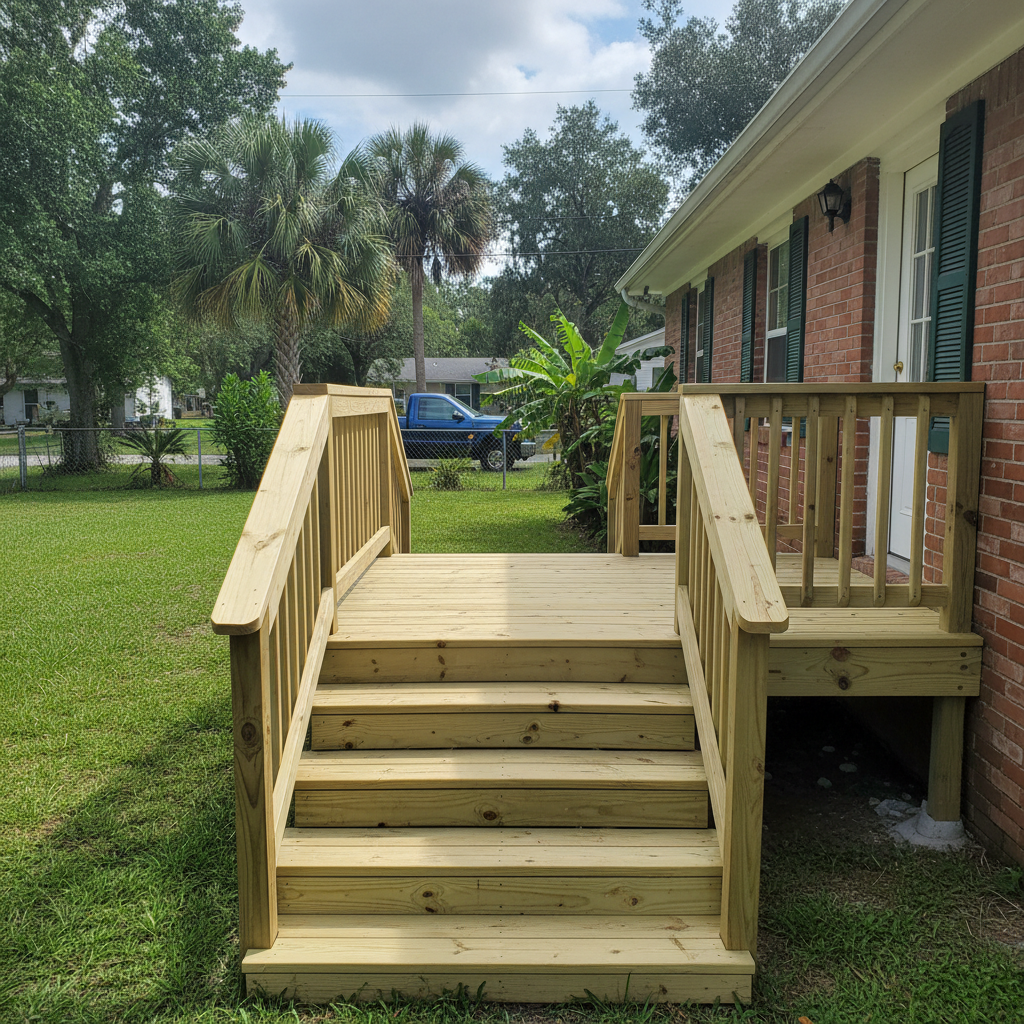
Most of what goes wrong on a deck job in Arcadia isn't bad lumber. It's something nobody looked at before the first post hole went in the ground. Here's what we check, and what you should ask about if someone else is doing the work.
What's actually under your yard
DeSoto County ground is mostly sandy flatwoods soil. It looks solid in April and turns soft and dark with standing water by August. A footing that bears fine on dry sand in the dry season can settle a half inch once the water table comes up in summer, and a half inch of settlement on one corner post is enough to rack a frame and crack a stain job within a year. We dig test holes before we pour, not after. Footings here generally need to sit on undisturbed soil at least 12 inches down, and if your lot is low or near a drainage swale, deeper and wider is cheaper now than jacking a deck later.
If your property backs up to the Peace River or sits in one of the lower-lying areas near it, ask whether you're in a mapped flood zone. That can change footing elevation and whether you need an elevation certificate before the county signs off.
Permits, setbacks, and the inspection clock
DeSoto County's building department issues the permit for most deck work, and a deck over about 30 inches off grade will need a guardrail at 36 inches minimum, with balusters spaced so a 4 inch sphere can't pass through. That's not optional and it's one of the first things an inspector checks.
- Setbacks. A current survey tells you your actual property lines. Side setbacks in a lot of Arcadia neighborhoods run 7.5 to 10 feet, rear setbacks more. People guess based on a fence line that's been wrong for twenty years.
- Septic fields. If your house is on septic, which a lot of the county is outside city water lines, a footing can't land on top of the drain field. We've had to redesign a layout around this more than once.
- HOA review. The newer subdivisions off SR 70 and SR 17 often have an architectural committee that wants a drawing before the county even sees it. The older in-town lots mostly don't. Ask first, it saves weeks.
The weather window and what it does to the build
Arcadia's rainy season runs roughly June through September, with afternoon thunderstorms that show up most days and a water table that rises with them. Digging and pouring footings in that stretch means fighting water in the hole and concrete that doesn't cure the way it should. We'd rather pour footings in the drier months, November through April, and finish decking and railing whenever the schedule allows.
Heat matters for materials too. Composite boards expand across their width in full Florida sun, which is why gapping between boards isn't cosmetic, it's engineered into the install. Pressure-treated pine that's still wet from the treatment plant will shrink as it dries out here, so fasteners set tight in July can start backing out by October. That's normal, not a defect, but it's worth knowing before you call someone back out over it.
Water, grading, and where it actually goes
A lot of Arcadia lots were graded decades ago with a gentle slope away from the house, and that slope has usually shifted with time, fill dirt, and whoever regraded for a pool or a shed. Before a deck goes in, we check where water sheets off the roof and where it pools after a downpour. A deck built low over ground that already holds water after every storm is a deck sitting in standing water for half the year, and that's where rot starts at the post bases first.
If downspouts dump near where the deck will sit, that water needs somewhere else to go before framing starts, not after.
The house itself: ledger, old lumber, and termites
How the deck attaches to your house depends a lot on when your house was built. Downtown Arcadia has homes going back to the early 1900s on pier and beam foundations with true full-dimension old-growth framing behind the siding. Newer subdivision homes are mostly concrete block, CBS construction, which means the ledger board isn't lagged to wood framing at all, it's through-bolted with sleeve anchors or Titen screws into the block with proper blocking behind it. Get this wrong and the deck pulls away from the house, which is one of the more dangerous failures because it usually happens quietly.
Florida subterranean termites are active in this part of the state year-round, more so in warm months. Treated lumber resists them in the field, but any cut end exposed during framing is untreated wood again, and that's an entry point if it's not field-treated with a copper naphthenate sealant before it goes into the ground or against a ledger. Ask whether that step is part of the build, because it's easy to skip and impossible to see once the decking's down.
Hardware matters as much as the lumber. Standard galvanized fasteners corrode fast in contact with modern ACQ-treated lumber, the chemical reacts with the zinc coating. Joist hangers, screws, and bolts touching treated wood should be hot-dip galvanized rated G185 or better, or stainless where it's exposed to the weather. A deck held together with the wrong hardware can look fine for two or three years and then fail at every connection at once.
Before you sign anything
Ask to see the survey, ask who's pulling the permit, and ask what the footing depth and hardware spec actually are, not just the square footage and the board color. Those three answers tell you more about how long the deck lasts than anything in the brochure. If you want a second set of eyes on a design or an existing deck before you spend money on either, that's the kind of walk-through we do as part of our deck builder work around Arcadia and the surrounding towns.