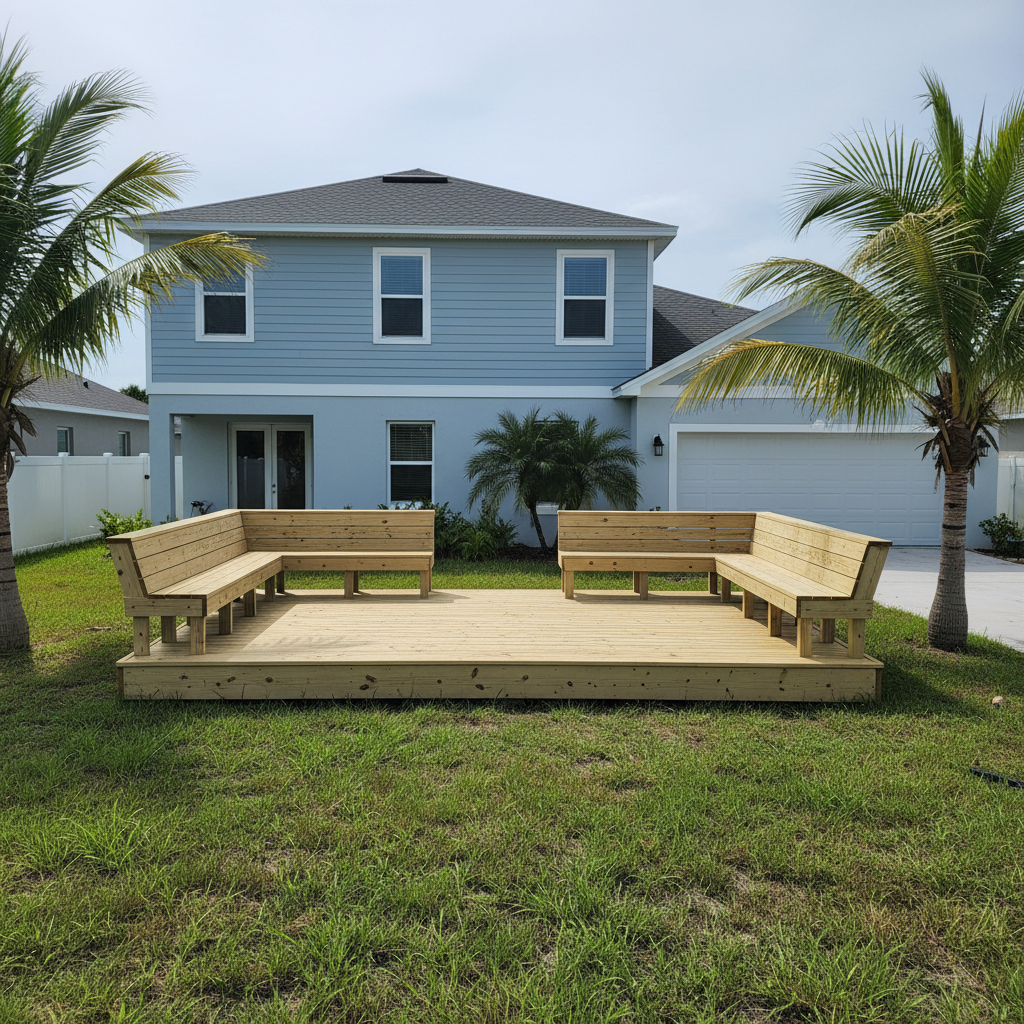
People ask us this more than almost anything else: when should I schedule this. The honest answer is that in DeSoto County, the calendar matters almost as much as the design does. Florida doesn't have a frost season to dodge, but it has something else that causes just as many headaches, and that's a six-month stretch of afternoon thunderstorms that can turn a two-week framing job into a month of rain delays.
The rainy season changes more than your comfort
From June through September, Arcadia gets rain almost every afternoon. Not all day, usually an hour or two starting around 2 or 3pm, but it's reliable enough that we plan around it. For demolition and framing, that means open stringers and exposed joists sitting wet overnight, which is exactly what pressure-treated lumber doesn't want. Wet lumber swells, and swollen lumber that then dries in July heat is how you get cupped boards and nail pops a year later.
Concrete footings are worse affected than people expect. A footing pour needs at least 48 hours before you can frame on it, longer if humidity keeps the surface from setting properly. In a dry stretch that's no problem. In a wet week, a crew can lose three or four working days just waiting for ground conditions to firm back up, especially on lots with sandy fill that turns to soup after an inch of rain.
Why November through April is when most decks here get built
This is the dry season for central Florida, and it's also the comfortable season, which matters when a crew is standing on a roof-level deck in direct sun. Humidity drops, afternoon storms mostly stop, and daytime temps sit in the 70s and low 80s instead of the mid-90s with heat index numbers that make August nearly unworkable past noon.
That dry stretch is also when stain and sealer actually behave. Most exterior wood sealants need 24 to 48 hours of dry weather to cure, and some composite capping or restoration products want even more. Apply a sealant the day before a pop-up storm rolls through in July and you've got lap marks and a surface that never bonds right. In January you can usually count on three or four dry days in a row without checking the radar every hour.
What the Peace River does to a schedule
Arcadia sits right along the Peace River, and this county has seen what a slow-moving storm can do to it. Hurricane Ian in 2022 pushed river flooding well past what anyone expected inland, and it's part of why we pay attention to elevation and drainage on every lot, not just the ones that look low. If your property sits near the floodplain or in a flood zone, that affects footing depth and sometimes requires the deck structure to sit higher off grade than it would on higher ground in town.
Hurricane season runs June 1 through November 30 on paper, but the real risk window for this part of the state is August through October. We don't start a large structural job, like a screened porch addition or a full rebuild, in the middle of that window if we can help it. A half-framed deck with no decking down is a liability in 60 mph gusts. Smaller jobs, repairs, railing swaps, board replacement, those we'll do any time of year because there's less exposure if weather turns.
New lumber has its own clock, separate from the weather
Even with perfect dry season timing, you can't stain brand-new pressure-treated lumber right away. The wood comes from the mill saturated with preservative and water, and it needs to dry out, usually four to six weeks in Florida's climate, before a stain or sealer will actually penetrate instead of sitting on the surface and peeling. We get asked to stain a new deck the week it's finished more than you'd think, and we always say wait. A sealant trapped under surface moisture fails within a season, and then you're paying to strip and redo something that was done too soon.
Composite decking skips that waiting period since there's no staining involved, which is part of why it's a popular choice for anyone trying to get a project finished on a tighter timeline. It has its own weather consideration though: composite boards expand and contract more than wood with Florida's temperature swings, so gapping between boards has to account for a 90-degree summer day versus a 55-degree January morning.
Permits don't run on the dry season, so plan ahead
DeSoto County issues the building permit for most deck construction, and the timeline for that is its own variable, usually a couple of weeks from application to approval depending on how busy the office is. Expect an inspection after footings are dug and before they're poured, and a final inspection once railing and stairs are in. If your lot is close to a property line or near the floodplain, a survey or setback check is often part of that process too. None of this moves faster in January than in July, so if you're hoping for a dry-season build, the smart move is to start the permit paperwork in the fall, not wait until the weather actually clears.
Older lots around the historic district tend to have mature trees and established grading that can complicate footing placement, while newer subdivision lots usually have more predictable, graded soil but sometimes less topsoil over fill. Either way, we check drainage on the actual lot before we commit to a timeline, because what the weather does on paper and what a specific yard does after a downpour aren't always the same thing.
If you're trying to pin down a start date for your own project, it helps to talk through your specific lot and what you're building before you lock anything in. That's a conversation we have with homeowners all the time at Valor Deck Co.